Summary
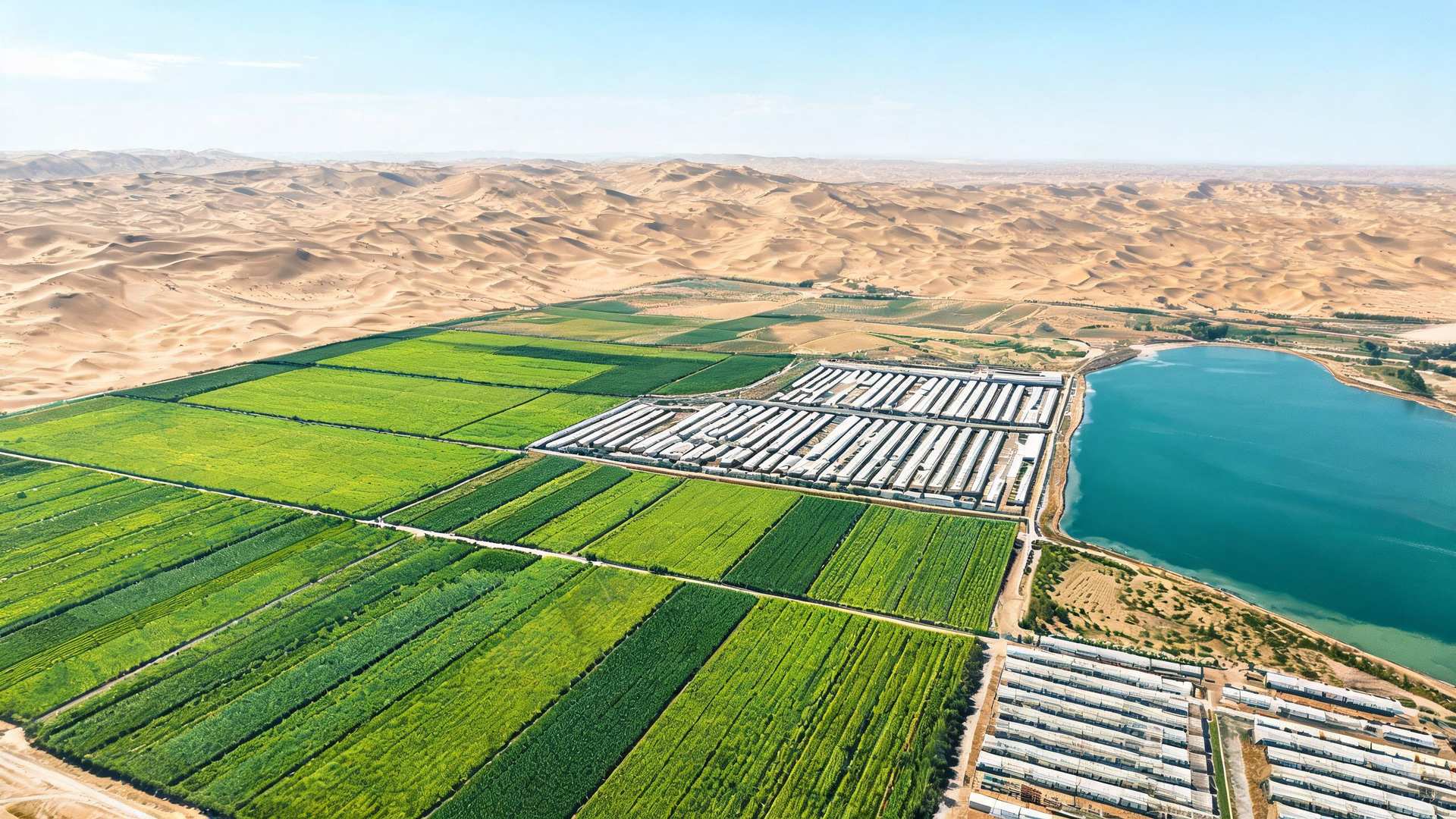
Veteran New Zealand dairy farmer Gavin Fisher, who has spent 27 years in the industry running a certified organic farm in the Waikato region of the central North Island, joined a 10-person delegation organised by a New Zealand agency and the International Federation of Organic Agriculture Movements Asia to visit a large-scale dairy operation with 100,000 cows on the edge of the Ulan Buh Desert in Inner Mongolia. The delegation toured one organic unit, which houses two 90-bail rotary milking platforms in a large barn and milks 8,500 cows. The herd consists of Holstein-Friesian cows of Australian bloodlines, milked three times a day with equipment running 24 hours, producing an average of about 43 litres per cow per day.
The farm employs dedicated nutritionists and veterinarians, keeps lactating cows indoors year-round, delivers harvested alfalfa and corn silage directly to the barn for feeding, and has calf-rearing facilities. The barn uses a fully temperature-controlled system to cope with desert temperatures that range from minus 20 degrees Celsius in winter to 40C in summer. The unit operates with just 50 shift workers, and apart from attaching milking cups manually, all processes are automated.
The farm relies on solar power, and most work vehicles are electric. Fisher said that through solid-liquid separation technology, manure is converted into compost and liquid nutrients, while biogas is used for on-site production, creating an efficient self-circulating ecosystem that can operate independently of the external power grid. Some land at the site is used for commercial crops, including pumpkins and liquorice, with irrigation water drawn mainly from the nearby Yellow River.
The desert development uses grid planting of nearly 100 million trees and grasses to block wind and sand erosion, and surplus sand from the construction phase is sold externally as road-building material. Fisher said the project involved not only substantial investment but also thorough thinking and attention to detail, demonstrating capacity for large-scale expansion, and New Zealand can learn from it — the key is to take action.
Commentary
The 100,000-cow operation on the edge of the Ulan Buh Desert in Inner Mongolia showcases the limits of scale and intensification, with fully temperature-controlled barns, 90-bail rotary milking platforms and 50 staff managing 8,500 cows. For small and medium-sized New Zealand dairy processors, it is not just a technical benchmark but a signal that the logic of global dairy competition is shifting: China is moving from being the largest import market towards partial self-sufficiency and could export cost-effective farming solutions in return. New Zealand dairy exports account for about 30 percent of the global total, and China is its largest single market, but China's dairy imports fell 12 percent in 2023 while domestic raw milk output rose 6.7 percent, narrowing the supply-demand gap.
If China replicates this desert dairy model, New Zealand's milk powder and liquid milk exports to China could face substitution pressure. However, New Zealand's competitive advantage lies in grass-fed, organic and animal welfare standards, which are difficult to replicate in China's indoor high-density farming. The self-circulating ecosystem Fisher described depends on huge capital investment and cheap land, and New Zealand farmers should focus on how to combine automation with their own pastoral systems rather than copying the model.
Chinese dairy companies such as Yili and Mengniu have already invested in building plants in New Zealand and may in future export the technical experience of desert dairy farms back, further integrating supply chains. NZ SMEs could explore providing professional services to China such as organic certification and carbon footprint accounting, or develop low-cost automation equipment suitable for small farms, seeking new growth points through differentiation.
Keywords: New Zealand dairy farmer, China dairy industry, Ulan Buh Desert, 100,000 cows, rotary milking platform, organic farm, self-circulating ecosystem, Gavin Fisher
Source: Sina.com
Disclaimer: This article is compiled from publicly available sources for general information only. The analysis and commentary are editorial opinions. MiDeer Observer does not guarantee the accuracy or completeness of the information provided. Readers should seek independent professional advice before relying on this content, or contact us for more information.