
Summary
New Zealand forestry export log prices have risen sharply recently, with A-grade short logs quoted above USD 131 per Japanese Agricultural Standard (JAS) at ports in the northern South Island, and some ports offering over USD 135/JAS to secure supply. However, the report notes the increase is not entirely driven by supply-demand imbalance but is more a result of lower shipping costs and exchange rate factors: the New Zealand dollar weakened after the Reserve Bank kept the Official Cash Rate (OCR) unchanged and remains about 1 cent lower than in mid-to-late October; the renminbi's rise to a four-year high against the US dollar also provided support. On shipping, slower global demand for Handysize vessels has pushed freight rates down, but the Pacific Basin route is performing better than the Atlantic route, and rates are expected to soften further this month.
Daily shipment volumes from Chinese ports are currently 65,000 cubic metres, and port inventories have fallen by 270,000 cubic metres from September to 2.3 million cubic metres, but a level closer to 2 million cubic metres would be needed to drive a significant rise in CFR prices. New Zealand supply will decline during the Christmas holiday period, potentially creating a gap for mid-February delivery dates, which coincides with the Chinese New Year holiday. The report also flags that China's manufacturing PMI fell to 49.3 in October (50.1 in September), with October PPI up 5.7 percent year on year and CPI up only 0.7 percent, squeezing manufacturer margins.
New Zealand building consents rose 18 percent year on year in September (21 percent in August), with Canterbury up 35 percent through end-September, while non-residential consents rose only 2.2 percent. The MPI ballot for ETS registration of LUC Class 6 land afforestation showed that the category for 100 hectares and above was oversubscribed, with only about 12,000 hectares of actual freehold titles submitted, less than one-tenth of the initial report; the current NZU spot price has risen to NZD 50.90 per unit.
Commentary
New Zealand log export prices have risen significantly recently, with A-grade short logs quoted above USD 131/JAS at northern South Island ports and some ports reaching over USD 135/JAS. The increase does not stem from a surge in Chinese demand but from a combination of lower shipping costs and a weaker New Zealand dollar. After the Reserve Bank kept the OCR unchanged, the NZD fell against the USD, while the renminbi rose to a four-year high against the US dollar, further boosting returns for New Zealand exporters.
For small and medium-sized New Zealand forestry exporters, short-term margins have improved somewhat, but they need to be alert to the structural factors behind the price volatility. Daily shipment volumes from Chinese ports are steady at 65,000 cubic metres, and inventories have fallen to 2.3 million cubic metres, but this is still some way from the key 2 million cubic metre level, meaning CFR prices are unlikely to rise sharply in the near term. China's manufacturing PMI fell to 49.3, and the gap between PPI and CPI has widened, putting pressure on manufacturer margins and potentially dampening subsequent log purchasing appetite.
New Zealand building consents rose 18 percent year on year, with Canterbury up 35 percent, supporting sawn timber demand, but non-residential consents rose only 2.2 percent, indicating weakness in the commercial construction market. On forestry carbon, in the ETS registration ballot for LUC Class 6 land afforestation, the 100-hectare-and-above category was oversubscribed, but actual freehold titles amounted to only about 12,000 hectares, less than one-tenth of the initial report, exposing multiple registration issues. The NZU spot price has risen to NZD 50.90, and future policy direction will depend on the formation of the new government, with carbon price volatility risks not to be ignored.
Reduced supply during the Christmas holiday may create a timing gap with Chinese New Year demand; if inventories fall below 2 million cubic metres after the holiday, prices could strengthen further in the second quarter. New Zealand forestry companies should monitor changes in shipping costs, Chinese manufacturing sentiment and the pace of conversion of domestic building consents, flexibly adjust the ratio of exports to domestic sales, and prudently assess the policy risks of carbon forestry assets.
Keywords: log export prices, Japanese Agricultural Standard (JAS), shipping costs, Chinese port inventories, manufacturing PMI, building consents, ETS afforestation registration, NZU carbon price
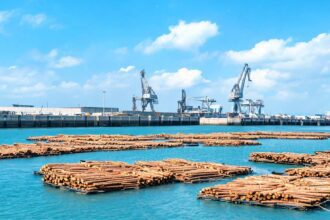
AI illustration on MiDeer Observer
Source: New Zealand Herald
Disclaimer: This article is compiled from publicly available sources for general information only. The analysis and commentary are editorial opinions. MiDeer Observer does not guarantee the accuracy or completeness of the information provided. Readers should seek independent professional advice before relying on this content, or contact us for more information.