Summary
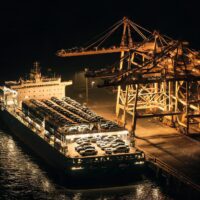
Tianjin Port is not the closest seaport to Northeast China, yet Heilongjiang Baifu Youxian Sheng Supply Chain Co Ltd and other firms have worked with it for 20 years. General manager Xu Xiaolei said the company imports 30,000 tonnes each of lamb and beef through Tianjin Port annually, with raw materials sourced from New Zealand, Australia, Brazil and other countries. Shipping from Australia to Tianjin Port takes 20-25 days, from Brazil 40-45 days, customs clearance about 4 days, followed by 2.5-3 days of road transport to Harbin, meaning a 28-tonne truckload of frozen meat can be in cold storage within a week of the vessel berthing.
Tianjin Port is also the company's distribution centre for finished products, hosting its largest national transit warehouse, with goods dispatched from the Xinhuiyang cold store at Tianjin Port to 16 or 17 regional sub-warehouses nationwide. In grain transport, a Changchun grain trading company ships 100,000 tonnes annually through Tianjin Port, on a sea-rail intermodal route that has run for six years since 2020. In July 2019, the Changchun Xinglong Comprehensive Bonded Zone and Tianjin Port Co Ltd signed a dry port co-operation agreement, launching the first Changchun-Tianjin Port sea-rail intermodal train and establishing a Tianjin Port office in Changchun.
In 2021, the first single-document international sea-rail intermodal train from Northeast China departed Changchun International Land Port via Tianjin Port for Egypt and the Philippines. Li Lin, general manager of Tianjin Port's Northeast regional service and marketing network, said that over seven years the route has reached as far as Qiqihar, carrying commodities including corn, starch, lysine products, diatomite, tyres, timber and clothing; at the end of 2020, corn deep-processing exports from Jilin province were shipped through Tianjin Port to Southeast Asia, New Zealand, the United States and elsewhere. In October this year, Tianjin Port Group launched its All-Link logistics service brand, setting out a vision of covering all cargo types, supplying full services, relying on full intelligence and achieving full connectivity.
Commentary
As a key hub in northern China, Tianjin Port's full-chain logistics services are reshaping international trade corridors for the Northeast hinterland. Heilongjiang Baifu imports 30,000 tonnes each of New Zealand and Australian lamb and beef through Tianjin Port annually, underscoring steady demand for NZ meat in the Chinese market. For NZ SMEs, Tianjin Port's cold-chain efficiency and reliable customs clearance reduce the logistics risk of entering Northeast China; frozen meat's high value demands end-to-end temperature control, and Tianjin Port's own cold stores and mature inspection processes provide assurance.
Meanwhile, the Changchun-Tianjin Port sea-rail intermodal train has run for six years, carrying commodities including corn deep-processing products, some of which are shipped to New Zealand, indicating trade complementarity between Northeast agricultural exports and New Zealand. Tianjin Port's All-Link brand extends services inland, and NZ firms can use its network to reach distribution channels in China's second- and third-tier cities more efficiently. However, Tianjin Port is not the closest seaport to the Northeast; its competitiveness lies in service reliability rather than freight rates, which suggests NZ exporters should assess timeliness and dependability when choosing logistics partners rather than pursuing low cost alone.
With the upgraded China-NZ free trade agreement, meat tariffs have fallen to zero, but non-tariff barriers such as inspection and quarantine remain key; Tianjin Port's experience in frozen goods inspection can help NZ exporters shorten clearance times and reduce the risk of cargo delays.
Keywords: Tianjin Port, cold-chain logistics, sea-rail intermodal transport, Northeast China, imported frozen goods, dry port, All-Link logistics service, Changchun, Heilongjiang Baifu
Photo by asmuSe on Pixabay
Source: Jinyun
Disclaimer: This article is compiled from publicly available sources for general information only. The analysis and commentary are editorial opinions. MiDeer Observer does not guarantee the accuracy or completeness of the information provided. Readers should seek independent professional advice before relying on this content, or contact us for more information.